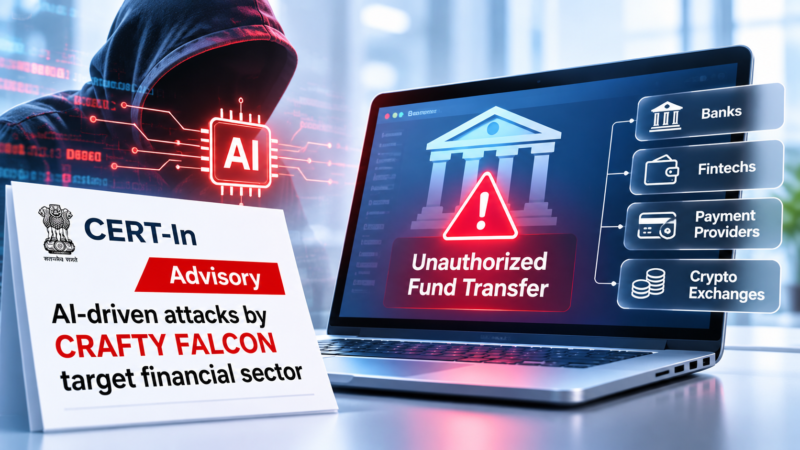
Attackers are automating intrusions and exploiting payment APIs, with some institutions targeted again despite earlier remediation.
India’s cybersecurity agency CERT-In has warned of an escalation in AI-assisted cyberattacks against banks’ non-bank financial counterparts, fintech companies, payment service providers and cryptocurrency exchanges, saying a threat actor it has named CRAFTY FALCON continues to exploit financial institutions’ own payment infrastructure to execute unauthorized fund transfers.
In a critical-severity advisory, CERT-In said attacks attributed to the group remain active, with its financial-sector incident response team, CSIRT-Fin, continuing to receive reports of successful intrusions. Some affected non-banking financial companies (NBFCs) and fintech firms had already received earlier security advisories and undertaken remediation, but were deliberately targeted again.
The advisory, CIAD-2026-0058, updates an October 9 warning about threat actors exploiting payment and disbursement application programming interfaces (APIs) to transfer funds without authorization.
CERT-In describes CRAFTY FALCON as an AI-assisted financial threat actor that uses machine intelligence to survey targets, operates at machine speed and executes attacks by invoking victims’ own payment and disbursement APIs.
The attackers have also timed operations to coincide with weekends, holidays and other periods when security monitoring is likely to be reduced, potentially delaying detection and response.
AI tools automate attack operations
CERT-In identified several publicly available AI-driven offensive security tools being used in the campaign, including the ARTEX family of large language model-based tools, PentAGI, an autonomous multi-agent AI penetration-testing system, and the Cairn attack search engine. The CyberStrikeAI framework was also identified.
According to the advisory, these tools can execute complete attack chains autonomously, generate large numbers of customized attack scripts and refine their payloads based on responses from targeted systems.
The agency also observed rapid successive variations of functionally similar scripts, a pattern it considers consistent with AI-generated code and iterative AI-assisted development.
The attackers rotate supporting infrastructure and IP addresses within hours or days, making conventional IP-based blocking less effective. CERT-In said detailed infrastructure fingerprints and detection rules have been shared with financial institutions through restricted advisories.
The use of AI tools is particularly significant because it allows attackers to automate activities that traditionally required substantial manual effort, including reconnaissance, vulnerability exploitation and the development of scripts tailored to individual targets.
Payment systems exploited from within
The attack campaign exploits weaknesses across cloud infrastructure, application environments and payment systems.
One identified entry point is internet-facing non-production environments, such as user acceptance testing (UAT), staging and testing servers. Attackers use these environments to gain initial access before moving into production systems through shared credentials, authentication tokens or network connections.
CERT-In also found that attackers reverse-engineered application codebases and developed customized exploits. They subsequently used modified application packages to initiate unauthorized API calls, bypassing controls that assumed only the legitimate application could communicate with the backend.
Another technique involves abusing IP allow-lists. Attackers route requests through trusted third-party fetcher services, including content-acceleration and app-store review infrastructure, whose IP addresses may already be permitted by financial institutions. Because these shared services can be induced to fetch arbitrary URLs, trusting their IP addresses alone does not establish that a request is legitimate.
The advisory also describes a pattern in which attackers initiate micro-value transactions, sometimes as small as Rs. 1, to verify that unauthorized fund transfers work before attempting larger transactions.
Merchant settlement APIs used by payment aggregators have also been exploited to move funds.
In other incidents, attackers targeted cryptocurrency exchanges and virtual digital asset service providers, stealing wallet keys and siphoning funds from cryptocurrency wallets.
CERT-In additionally reported the exploitation of newly disclosed vulnerabilities, including file-upload and deserialization weaknesses in PHP and Node.js applications, to deploy web shells.
Repeated attacks expose remediation gaps
The continued targeting of previously affected organizations raises questions about the effectiveness of incident remediation and the separation of production and testing environments.
CERT-In has advised financial institutions to assume that attackers may retain access following an incident and to conduct complete eradication, forensic verification and periodic threat hunting rather than relying on initial containment.
The agency has called for stronger isolation between non-production and production environments, with no shared credentials, API keys, databases or direct network paths. Internet-facing testing environments should also receive production-grade security controls and monitoring.
It has recommended centralized, real-time monitoring of cloud audit logs, particularly for remote command execution, serverless function code changes and the creation of new user accounts, roles and access keys.
For payment infrastructure, CERT-In wants organizations to enforce server-side validation of every transaction, use cryptographically signed API requests with nonces and timestamps, and introduce application attestation to detect modified or repackaged client applications.
Financial institutions should also flag small-value transactions to new beneficiaries when followed by large transfers, implement transaction velocity controls and introduce cooling periods for newly added beneficiaries.
The agency has further advised organizations to monitor unauthorized downloads and execution of offensive AI security tools, govern the use of large language model APIs and restrict outbound network traffic to approved destinations.
CERT-In has urged affected entities to maintain round-the-clock monitoring, with additional security coverage during weekends and holidays. Suspicious activity should be reported to CERT-In and CSIRT-Fin at incident@cert-in.org.in.
The advisory signals a growing challenge for financial institutions: AI is not merely helping attackers discover vulnerabilities faster but is also enabling them to automate and adapt attacks across interconnected cloud, application and payment environments.