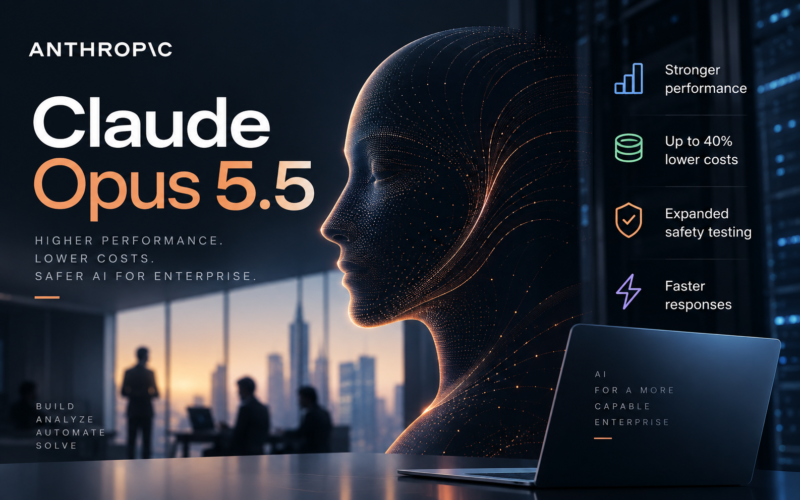
The company claims new model reduces operating costs by up to 40% while improving performance and resistance to prompt injection
Anthropic has introduced Claude Opus 5.5, a new flagship AI model that the company said delivers improved performance while reducing compute costs and strengthening alignment safeguards. The release marks the first model in Anthropic’s Claude 5.5 family and follows its earlier call to pace the development of frontier AI systems.
Anthropic said Opus 5.5 performs at a level comparable to its higher-tier models on most tasks while costing significantly less to run. The company said the model requires less compute than its predecessor, Opus 5, with typical workloads costing about 40% less.
Performance improvements for complex workloads
Anthropic said Opus 5.5 is designed for complex, long-running enterprise workloads, including large-scale software development and knowledge work. The company said early testers reported improvements in handling codebase-wide tasks and system optimization.
In one test cited by Anthropic, the model completed a large code migration involving hundreds of thousands of lines in less than a day. In another example, the company said Opus 5.5 successfully reduced load times across nearly all pages of a web application, outperforming Opus 5 in both consistency and accuracy.
Anthropic also said the model is optimized for long and “sprawling” tasks such as code audits and system rewrites. In one internal test, Opus 5.5 completed a full translation of HAProxy code from C to Rust faster and at lower cost than another Claude model, while passing nearly all regression tests.
The company added that Opus 5.5 generates outputs more than 30% faster than Opus 5 and is priced at $4 per million input tokens and $20 per million output tokens, lower than the previous model. Cache read pricing, which Anthropic said accounts for a large portion of agentic and coding workloads, is reduced by 60%.
Alignment testing and safety controls
Anthropic said Opus 5.5 achieved its highest scores to date on its automated behavioral audit, an internal alignment test that evaluates model behavior across thousands of simulated scenarios. The company said the model is less likely than earlier versions to take irreversible actions or operate outside defined constraints.
The model was also tested by external evaluators, including Frontier Design and the Model Evaluation & Threat Research (METR) group, prior to release, Anthropic said.
Anthropic said Opus 5.5 shows improved resistance to prompt injection attacks compared with Opus 5 and that its alignment testing has been expanded to include longer tasks, “impossible” tasks, and scenarios modeled on real-world incidents.
Given its capabilities in domains such as cybersecurity and biology, Anthropic said it is deploying Opus 5.5 with safeguards similar to those used for its most advanced models. The company said organizations will need to undergo verification to use the model in certain life sciences and cybersecurity applications.
Enterprise impact: cost, control, and deployment
Anthropic said the reduction in compute requirements and token pricing is intended to lower the cost of running large-scale AI workloads, particularly in coding and agentic use cases. The company added that lower cache pricing is designed to reduce the cost of repeated interactions in such workflows.
On the security side, Anthropic said improvements in alignment and testing are aimed at reducing unintended model behavior, including actions outside defined parameters and susceptibility to adversarial inputs.
The company also indicated that verification programs for sensitive domains are part of its approach to managing higher-risk use cases, particularly where AI capabilities intersect with cybersecurity and scientific research.
Broader context: efficiency and real-world performance
Anthropic said that at current capability levels, benchmark differences between models are becoming less indicative of real-world performance. The company added that in its own testing, the performance gap between Opus 5.5 and other advanced models is narrower than benchmark scores suggest.
The company said Opus 5.5 performs strongly across agentic coding, business workflows, and knowledge work evaluations, including tests designed to simulate real-world enterprise tasks.
In one internal evaluation, Anthropic said Opus 5.5 produced high-quality analytical reports with fewer errors than earlier models, meeting strict accuracy thresholds across multiple attempts. The model also demonstrated improved performance in financial analysis and business decision workflows, according to the company.
What enterprises should watch
Anthropic said additional models in the Claude 5.5 family, including Sonnet 5.5 and Haiku 5.5, will be released in the coming weeks with similar improvements in performance, efficiency, and safety.
The company also said it plans to expand access to Opus 5.5 through its verification programs, including broader availability for cybersecurity practitioners.
For enterprise IT teams, the rollout of Opus 5.5 introduces a model that Anthropic said is designed to balance performance, cost, and safety controls as organizations scale AI into production environments.