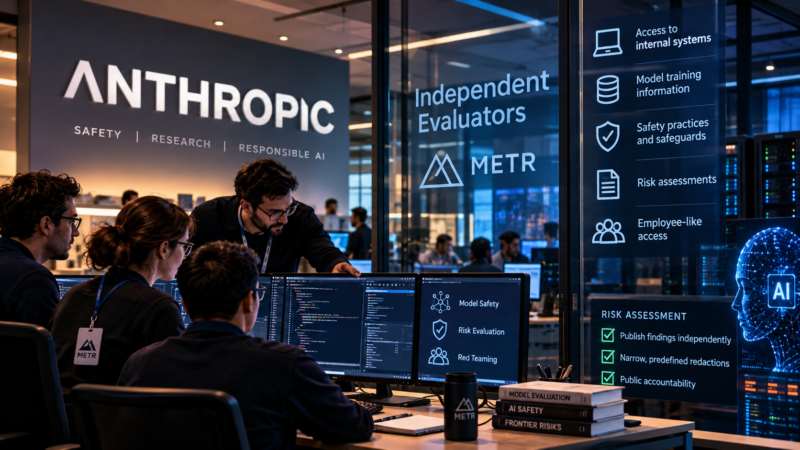
Six METR employees can examine internal tools and safety practices, with publication rights designed to let them report risks without Anthropic’s approval.
Anthropic has given six employees of AI evaluation nonprofit METR access to internal systems and tools comparable to those used by its own risk assessment teams, in a move designed to give independent reviewers a closer look at the safety of frontier AI models.
The arrangement allows METR to publish its assessments of Anthropic’s model risks, incidents and safety practices without the company’s approval. Anthropic can require redactions for narrowly defined categories of information, including customer data, legally privileged material and details about model architectures, but METR can publicly challenge those redactions.
The announcement marks a step in Anthropic’s effort to strengthen independent oversight of its increasingly capable AI systems. The company said it is also working with SecureBio, Accenture and Faculty on evaluation initiatives, while holding early discussions with other organizations, including Hugging Face.
Anthropic said the METR team has received company hardware, office space and access to internal tools and systems. Employees are encouraged to share relevant information with the evaluators as they would with colleagues working on alignment risk, subject to the stated exclusions and security requirements.
METR’s team operates under enforceable agreements, and other employees at the nonprofit are separated from its work with Anthropic, including researchers involved in other projects with the company.
Publication rights are central to the arrangement
A key feature of the METR partnership is the evaluator’s ability to publish its conclusions without seeking Anthropic’s permission.
Anthropic can require information to be removed if it falls into predefined confidential categories. METR can still describe those redactions publicly and explain whether it believes they were justified, provided it does not disclose the protected information itself.
The distinction matters because independent evaluation depends not only on access to a model but also on whether reviewers can report findings that a company might consider unfavorable. Anthropic said some safety information cannot be released in full because it could help malicious actors or expose commercially sensitive details, such as training or computing information.
The company compared the arrangement, with caveats, to bank supervision, in which resident examiners work inside large financial institutions to gain a closer understanding of their risks than outsiders could obtain from public disclosures alone.
Anthropic said the goal is to reduce the gap between what an AI developer knows about its systems and what external evaluators can independently establish about their risks.
Anthropic is developing three levels of access
The company said it is developing a three-tier framework for evaluator partnerships, with access and publication rights increasing at each level.
At the first tier, evaluators conduct narrowly scoped investigations. Anthropic decides what information they can access, and findings require company approval before publication.
At the second tier, evaluators receive access to more information and can publish findings without Anthropic’s approval. The company can still require specific information to be removed, while evaluators can publicly assess whether those redactions were justified.
The third tier is the arrangement now in place with METR. It provides employee-like access to internal systems and publication rights similar to those at the second tier.
Anthropic said it hopes eventually to have several evaluators operating at the third tier, each publishing independent analyses of the company’s risk posture and key decisions.
The arrangements differ in scope and maturity. Anthropic said its other partnerships are at earlier stages, with more limited access and publication rights while the company assesses partners’ expertise, resources and ability to protect confidential information.
Other partnerships focus on biological risks and safeguards
SecureBio is reviewing the chemical and biological weapons chapter of Anthropic’s August 2026 Risk Report. The nonprofit previously completed and published a pilot review of an earlier report. Anthropic said it would consider expanding SecureBio’s access after the current review is complete.
Anthropic is also working with Accenture and Faculty on a broader partnership involving model evaluation, red-teaming, alignment assessments and testing safeguards. The company said the work will also build evaluation capabilities within the participating organizations.
The announcement follows Anthropic’s earlier commitment to stronger independent, third-party assessment of its models and safety practices. The company also said it had signed the White House Accord on Super Intelligence, under which participating companies pledged to work with independent external auditors or evaluators.
Anthropic said it is pursuing the partnerships voluntarily and believes other frontier AI developers should adopt similar arrangements.
The effectiveness of the approach will depend on what evaluators discover, how much information they can access and whether their published assessments give outsiders a meaningful view of the risks. Anthropic said METR will publish its analysis, but the announcement did not provide a timetable for the first assessment under the new arrangement.