The Claude maker’s SEC filing offers a rare look at the economics of enterprise AI, its dependence on computing infrastructure and the safety and security risks businesses must weigh when choosing AI providers.
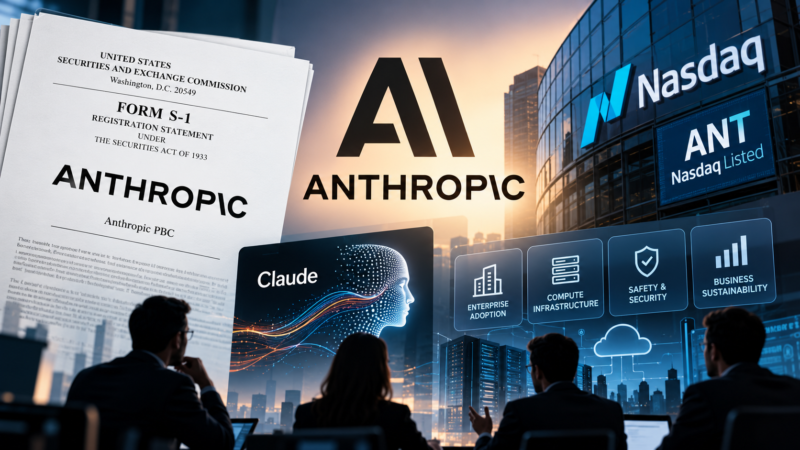
Frontier AI Company Anthropic filed a registration statement with the U.S. Securities and Exchange Commission (SEC) on October 26, 2026, proposing its initial public offering (IPO) to list its Class A common stock on Nasdaq under the ticker symbol ANT. Although the filing is primarily intended for prospective investors, it also provides information relevant to enterprises evaluating Anthropic as an AI supplier.
The document describes a business experiencing rapid revenue growth, expanding enterprise adoption and substantial commitments to computing infrastructure. It also highlights risks involving model behavior, security, computing availability and the continued investment required to develop advanced AI systems.
For CIOs and other technology leaders, the filing is not a reason by itself to change an AI procurement decision. It is an opportunity to examine the business and operational factors behind a provider whose models are increasingly being used in enterprise applications and software development.
What does Anthropic’s filing reveal about enterprise adoption?
Anthropic reported $16.286 billion in revenue for the six months ended June 30, 2026, compared with $1.163 billion in the same period a year earlier. The figures illustrate the speed at which demand for its AI services has grown.
The company’s customer disclosures provide a more direct indication of enterprise adoption. As of September 30, 2026, Anthropic had more than 11,900 customers generating at least $100,000 in trailing-12-month revenue, according to the S-1.
The company delivers Claude through its models, developer platform and applications, allowing businesses to use the technology in different ways, from integrating models into their own software to deploying AI-powered applications and coding tools.
For enterprises, the distinction matters because AI adoption is no longer limited to employees using chatbots. Organizations are incorporating models into software development, business processes and applications that may have access to corporate data and operational systems.
However, the filing does not establish how effectively individual customers are using Claude or what returns they are achieving. Enterprises still need to evaluate performance, reliability, security and total cost against their own workloads.
Why should enterprises care about Anthropic’s computing costs?
Delivering advanced AI services requires substantial computing capacity. Anthropic must secure resources for model training, research, product development and the inference workloads generated by customers.
The company reported $8.945 billion in compute and infrastructure expenses in the first half of 2026, compared with $2.334 billion in the same period of 2025.
Anthropic describes its infrastructure strategy as drawing on multiple technology partners and different processor architectures, including AWS Trainium, Google TPUs, Nvidia GPUs and AMD GPUs. It says this approach allows it to allocate computing resources according to where they are expected to be most productive.
The company also discloses extensive purchase commitments and lease agreements associated with computing and infrastructure. These commitments can extend well beyond the period in which a contract is signed, creating financial obligations that persist even as demand, technology and model economics change.
For enterprise customers, this raises questions about the sustainability of AI service pricing and the availability of computing capacity as demand grows.
The filing does not establish that Anthropic will raise prices or reduce service availability. But it illustrates why enterprises should assess pricing terms, usage limits, service-level commitments and alternative deployment options rather than assuming that current AI economics will remain unchanged.
What do the financial disclosures mean for customers?
Anthropic’s rapid revenue growth is accompanied by substantial spending and complex financial results.
The company reported an operating loss of $693 million for the first half of 2026. Its reported net loss was much larger, at $80.748 billion, but included a $72.388 billion negative change in the fair value of convertible notes, derivative liabilities and simple agreements for future equity.
The distinction is important. The reported net loss should not be interpreted as cash consumed entirely by operating Claude services. At the same time, the narrower operating loss does not establish that Anthropic has achieved sustainable profitability.
For enterprise buyers, the relevant question is not whether a supplier reports a particular quarterly profit or loss. It is whether the supplier has the financial resources, infrastructure and operational capacity to support the services on which customers depend.
Anthropic says it expects to continue investing heavily in computing, research, employees and product development. Those investments support its competitive position but also create ongoing financial and execution risks.
Enterprises considering long-term deployments should therefore examine contractual protections, data portability, exit provisions and contingency plans. These are sensible procurement practices for any strategically important technology supplier, not evidence that Anthropic is facing an imminent service disruption.
What does the filing say about AI safety and security?
The S-1 is also relevant to organizations assessing the risks of deploying increasingly capable AI systems.
Anthropic explicitly warns that model behavior can be unpredictable. Its risk disclosures state: “Our AI models may behave in unintended, misaligned, or autonomous ways, including by taking harmful actions that no user or third party directed.”
The company also identifies risks associated with malicious use, failures of safeguards and vulnerabilities in its systems.
These disclosures matter particularly when enterprises connect AI models to internal applications, source-code repositories, databases, cloud consoles and other tools. The consequences of a model error depend not only on the model itself but also on the permissions it has, the data it can access and the controls surrounding its actions.
The filing does not demonstrate that Claude has caused a particular enterprise security incident. Rather, it makes clear that model behavior and safeguard effectiveness are risks organizations must account for when deploying AI.
CIOs and CISOs should consequently assess access controls, logging, human approval requirements, isolation boundaries and the ability to revoke an agent’s permissions. They should also test models against their own threat scenarios instead of relying solely on provider assurances.
Anthropic’s emphasis on safety is part of its stated business strategy, but enterprises still need independent validation and governance appropriate to their use cases.
How should enterprises evaluate their dependence on Anthropic?
The IPO filing does not change an enterprise’s contractual relationship with Anthropic by itself. Nor does it establish that the company will alter its products, pricing or service commitments after going public.
It does, however, provide a useful basis for reviewing supplier risk.
Organizations using Claude in critical workflows should understand how their applications depend on Anthropic’s APIs and infrastructure, whether they can switch models without major redevelopment, and how they would continue operating if a service became unavailable or its terms changed.
They should also evaluate data handling, retention, regulatory requirements and the implications of embedding a proprietary model deeply into business processes. Where appropriate, maintaining the ability to use alternative models can reduce dependence on a single provider.
These considerations are particularly important when AI becomes part of a production application rather than remaining an optional productivity tool.
The goal is not to avoid dependence on AI providers altogether. It is to make that dependence visible, manageable and consistent with the organization’s operational and security requirements.
What comes next?
Anthropic’s S-1 gives enterprises a more detailed view of the business behind Claude, but it does not answer every question about the future of its services.
The IPO process will determine the final offering terms and may produce amended disclosures. The company’s subsequent financial reports should provide further evidence about customer growth, infrastructure spending and its ability to sustain operations as demand expands.
For enterprise technology leaders, the most useful takeaway is broader than the IPO itself. Advanced AI is becoming a significant technology dependency, and choosing a provider requires more than comparing model capabilities or benchmark results.
Financial resilience, computing capacity, security controls, governance and the ability to move workloads elsewhere all belong in the evaluation.
Anthropic’s public filing makes those considerations more visible. Enterprises should use that information as one input into their supplier assessments, alongside technical testing, contractual review and their own security requirements.