The initiative gives selected organizations access to Claude Mythos to find and fix software vulnerabilities. Its latest findings show how AI could accelerate security research — and why fixing the flaws may be harder than finding them.
Imagine an AI system that can examine millions of lines of software code, discover a hidden security weakness and help developers write a fix. Now imagine that the same capability could help a cybercriminal find a way into a vulnerable system.
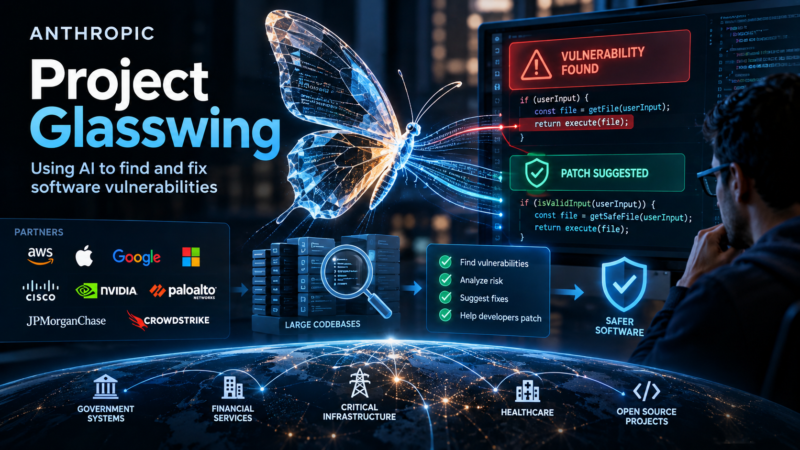
That is the challenge Anthropic is trying to address with Project Glasswing, an initiative launched in April 2026 to use advanced AI to find and fix vulnerabilities in critical software before attackers can exploit them.
The project brings together Anthropic, major technology companies, cybersecurity providers and open-source organizations. They use Anthropic’s Claude Mythos Preview model to examine software and infrastructure, identify weaknesses and develop fixes.
Glasswing is not a new cybersecurity product available to everyone. It is a restricted-access initiative: participating organizations are selected because they develop, maintain or protect important software and infrastructure. The idea is to give defenders access to powerful AI capabilities while limiting the risk of those capabilities being misused.
Why did Anthropic launch Project Glasswing?
Software vulnerabilities are weaknesses in code that attackers can exploit to steal information, gain unauthorized access or disrupt services. Security researchers have long used tools such as code scanners, automated testing and manual reviews to find these flaws.
But complex software can contain millions of lines of code, with weaknesses that emerge only when different components interact. Finding such problems can require an investigator to follow a chain of events across a large application.
Anthropic says Claude Mythos Preview can carry out this kind of investigation and work through multiple steps to identify vulnerabilities and help develop patches. Because the model can also be used for offensive security work, Anthropic decided not to release it publicly.
At Glasswing’s launch on April 7, Anthropic named 12 participating organizations, including Amazon Web Services, Apple, Broadcom, Cisco, CrowdStrike, Google, JPMorganChase, the Linux Foundation, Microsoft, NVIDIA and Palo Alto Networks, alongside Anthropic itself.
The company also extended access to more than 40 additional organizations responsible for critical software infrastructure. It committed up to $100 million in model usage credits and $4 million in direct donations to open-source security organizations.
What has Project Glasswing found?
The initiative’s reported results offer an indication of how quickly AI-assisted security research could expand vulnerability discovery.
In an Oct. 6 update, Anthropic said Glasswing partners had identified at least 129,000 verified software vulnerabilities between April and July. More than 33,000 were rated high or critical severity. Anthropic also reported finding another 5,500 verified vulnerabilities through its own open-source scanning work between April and October.
These are company-reported figures, not an independently audited count of vulnerabilities. Anthropic said the partner data came from 33 organizations and was incomplete. The company believes the actual number of findings could be substantially higher.
The figures also do not mean that 129,000 systems were breached or that every vulnerability could be exploited in practice. A vulnerability is a weakness that may create a security risk; its severity and exploitability depend on the software, configuration and circumstances.
The more difficult task may come after discovery. Each finding needs to be checked, prioritized and reported to the people responsible for the affected software. Developers must then create and test fixes, while organizations decide when and how to deploy them.
If AI finds vulnerabilities faster than maintainers can fix them, the result could be a larger backlog rather than better security. Glasswing is therefore testing not just AI’s ability to discover weaknesses, but also the industry’s ability to turn those discoveries into safer software.
What changed in October?
On Oct. 6, Anthropic announced an expanded Cyber Verification Program (CVP), bringing its earlier cyber-access efforts, including Glasswing, into a broader framework.
The program has three access tiers: Defense Access, Red Team Access and Specialized Access. Each is designed for different security tasks, with access and safeguards varying according to the work being performed. Existing Glasswing members will move to the Specialized Access tier. The expanded program includes Claude Opus 5.5, Sonnet 5.5 and Mythos 5.1, among other models.
The change is intended to let more security professionals use advanced AI for legitimate defensive work while keeping tighter restrictions on higher-risk activities.
Anthropic reported that its safeguards blocked 46 of 50 tasks in a cyber evaluation when Opus 5.5 was used in Defense Access. Under Red Team Access, the model completed 34 of 50 tasks, matching its completion rate without safeguards. These are Anthropic’s own test results, not independent measures of real-world security performance.
How are OpenAI and Google approaching the same problem?
Anthropic is not the only AI company trying to help defenders find and fix software vulnerabilities.
OpenAI’s Daybreak brings together AI models, security tools and partners to help approved defenders investigate vulnerabilities, validate findings and develop fixes. Its Codex Security tools support code scanning and patch development. OpenAI said Codex Security had scanned more than 30 million commits across over 30,000 codebases. Human reviewers had marked more than 70,000 findings as fixed, while more than 500,000 findings had been automatically identified as fixed, according to the company.
In September, OpenAI also announced a $1 billion commitment over six months to subsidize Daybreak access, training, technical support and partnerships for organizations protecting essential services, including local governments, utilities, community banks and open-source projects.
Google’s efforts include Big Sleep and CodeMender. Big Sleep focuses on finding software vulnerabilities, while CodeMender is an AI agent designed to investigate weaknesses and develop fixes. Google says CodeMender uses automated analysis and testing to check proposed patches, with human researchers reviewing fixes before submission to open-source projects. Google also participated in Project Glasswing.
Meta’s approach is broader. Its Advanced AI Scaling Framework sets out how the company evaluates risks from its most capable models, including cybersecurity threats, before training and deployment. Unlike Glasswing and Daybreak, it is primarily a framework for model safety and risk management rather than a dedicated, restricted-access vulnerability-discovery program.
The approaches differ, but the shared concern is the same: AI can help defenders work faster, while also making advanced cyber capabilities more accessible to potential attackers.
What does Glasswing mean for security teams?
For cybersecurity teams, Glasswing points to a future in which finding software weaknesses may become faster and less dependent on scarce specialist expertise. It could help organizations examine code more thoroughly, investigate reported vulnerabilities and develop fixes.
But AI does not remove the need for human judgment. Security researchers still need to verify findings, developers must test patches, and organizations must make sure fixes do not introduce new problems. Companies also need to decide which weaknesses to address first and how quickly they can deploy changes without disrupting critical systems.
There is also an access question. Large technology companies and critical infrastructure operators may be better positioned to obtain advanced models than smaller organizations that maintain important open-source software. Programs such as Glasswing and Daybreak aim to widen access for defenders, but their effectiveness will depend on who qualifies and whether the resulting fixes reach the software people actually use.
Project Glasswing is ultimately an attempt to get ahead of a difficult problem: AI may allow vulnerabilities to be found at a much faster pace, but security improves only when those vulnerabilities are fixed. The initiative’s lasting value will depend on whether it helps organizations close that gap before attackers can take advantage of it.