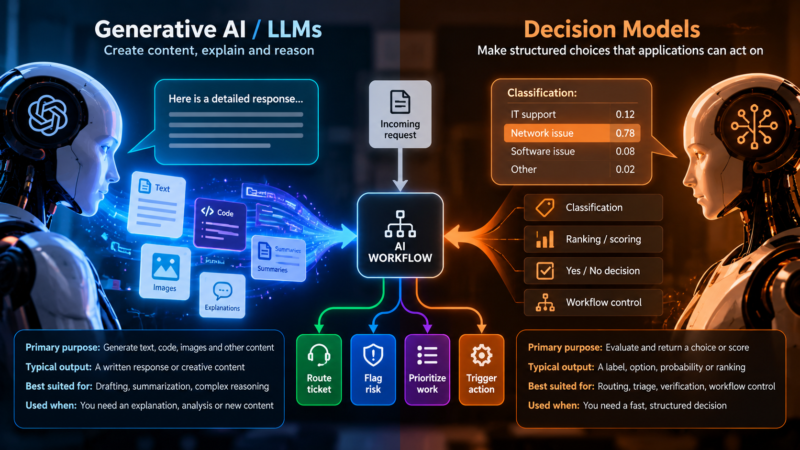
Designed to return choices, classifications and scores rather than generated text, decision models could help enterprises build faster, more cost-efficient AI workflows.
Artificial intelligence has become closely associated with systems that write emails, generate code, summarize documents and answer questions. These capabilities are powered largely by generative AI models, including large language models (LLMs).
But many business applications do not need AI to create anything. They need it to make a choice.
A customer support system must decide which team should handle a complaint. A security platform needs to determine which alert deserves immediate attention. An AI agent may need to decide whether to call a tool, try another approach or ask a human for help.
These are decision tasks. And a growing category of AI models is being designed specifically to handle them.
Microsoft brought renewed attention to this approach in October 2026 with the launch of Microsoft-Decision-1, a model built to make fast, structured decisions. It is designed to classify information, route requests, prioritize work and evaluate AI-generated responses without producing the lengthy answers associated with conventional LLMs.
The idea, however, is broader than one product: use the type of AI best suited to the task, rather than asking a general-purpose model to do everything.
What exactly is a decision model?
A decision model takes information about a situation and produces an output that helps determine what should happen next.
That output might be a yes-or-no judgment, a category, a ranking or a score. Instead of generating a paragraph explaining a recommendation, the model returns a result that software can use directly.
Consider an IT service desk receiving thousands of support requests. A generative model could read a request, explain the problem and draft a response. But before doing any of that, the system may need to answer a simpler question: Is this incident urgent?
A decision model can assess the request and return a score or classification. The service desk software can then send it to the right team, place it in a priority queue or escalate it for human review.
The same principle applies to cybersecurity. A security operations platform might use a decision model to classify an alert as routine, important or urgent, based on information supplied to it. The application can use that result to prioritize an investigation, while an analyst or another AI system performs deeper analysis where needed.
The model is not necessarily making an unrestricted decision on its own. Developers define the question, the possible outcomes and the rules governing what happens next. The model supplies a judgment; the surrounding application determines how to use it.
The term decision model is still emerging as a distinct product category. It should not be confused with every AI system that makes decisions. Traditional machine-learning classifiers, ranking systems and reinforcement-learning policies have long supported decision-oriented tasks, although they work in different ways.
How are decision models different from generative AI?
The most important difference is the kind of output each model is designed to produc
| Capability | Generative models and LLMs | Decision models |
| Primary purpose | Create text, code, images or other content; answer open-ended questions | Evaluate a situation and return a defined choice, classification or score |
| Typical output | A written answer, generated code or summary | A label, selected option, probability or ranking score |
| Best suited for | Drafting, summarization, explanation, complex reasoning and content creation | Routing, triage, prioritization, verification and workflow control |
| How applications use the output | Often need to interpret or validate generated content | Can use structured results directly in application logic |
| Main trade-off | Broad capability, but potentially higher latency and cost for simple repeated tasks | Efficient for bounded decisions, but limited by the questions and information supplied |
LLMs are trained to predict and generate sequences of tokens. That capability allows them to handle a wide range of language tasks, including some forms of reasoning. But when an application only needs a classification or a choice from a fixed list, generating a detailed response may be unnecessary.
A decision model is optimized for that narrower job. It can return a structured result without generating an explanation that the application does not need.
This does not mean generative models cannot classify information. They can. Nor does it mean decision models are always more accurate, cheaper or faster. Those outcomes depend on the task, model, implementation and workload. The distinction is about specialization: a model designed for a particular decision may be more efficient than a general-purpose model used for the same task.
Microsoft-Decision-1: A practical example
Microsoft-Decision-1 illustrates how this approach works in practice.
Available through Microsoft Foundry and OpenRouter, the model accepts a situation and a question with defined answer options. It then returns probabilities for those options rather than a free-form response. Microsoft says the model supports yes-or-no judgments, multiple-choice decisions, ratings and rubric-based evaluation of AI responses and agent actions.
Imagine a company wants to route incoming IT tickets to one of three teams: network operations, identity management or application support. The application supplies the ticket details and the three possible destinations. The model selects the most appropriate option and returns associated probability scores.
The software can then route the ticket automatically if the result meets its confidence threshold. If the model is uncertain, the application can send the ticket to a human instead.
Microsoft says Decision-1 was post-trained from Qwen3.5-9B and evaluated across 36 benchmarks covering nearly 150,000 questions. The company reported that it achieved the highest accuracy in its comparison and was 2.5 times faster than the runner-up model and 35 times faster than GPT-6 Sol in its tests. These are Microsoft’s benchmark results, not an independent guarantee of performance across enterprise workloads.
The model also has limits. It is not designed for open-ended conversation, summarization or content generation. Microsoft’s documentation says it should not be used as the sole automated decision-maker for consequential decisions about people, such as employment, credit, housing or healthcare.
Decision models are not entirely new
Although the label is gaining attention, AI systems have been making classifications and supporting decisions for years.
A bank’s fraud detection system, for example, may estimate whether a transaction is suspicious. A recommendation system ranks products or films according to their relevance to a user. A predictive maintenance model estimates the likelihood of equipment failure so a company can decide when to inspect a machine.
These systems are related to the broader idea of decision-oriented AI, but they are not necessarily the same as a modern decision model such as Decision-1. Fraud detection and predictive maintenance models often estimate the likelihood of an event; recommendation systems rank alternatives; decision-scoring models evaluate a situation against specified choices.
Reinforcement learning offers another approach. A model learns a policy for selecting actions based on states, rewards and experience. Such systems can be used in robotics, resource allocation and other environments where actions affect what happens next. Unlike a model that scores a fixed set of options in a single request, a reinforcement-learning policy may be designed to make sequences of decisions over time.
The common thread is that the AI is being used to select, evaluate or guide an action rather than simply generate content.
Why enterprises may combine the two
The strongest use case for decision models may be alongside generative AI, not as a replacement for it.
An AI-powered support workflow, for instance, could use a decision model to classify a request, determine its priority and select the appropriate tool. A generative model could then investigate a complex problem, explain the findings and draft a response. A further decision step could check whether the response meets defined criteria before it is sent to the customer.
This division of work could reduce unnecessary calls to large models, shorten response times and make costs more predictable in high-volume applications. It could also make workflows easier to control because applications receive structured outputs they can evaluate against predefined thresholds.
But enterprises should not assume that adding a decision model automatically makes an AI system safer or more reliable. A model can return a confident but incorrect classification. Poorly defined choices, incomplete input data and badly selected confidence thresholds can still lead to mistakes.
Organizations need to test models against their own workloads, measure the consequences of incorrect decisions and decide when human review is required. For security-sensitive tasks, a decision score should be one part of a broader control system, not a substitute for access controls, validation and monitoring.
The bigger picture
Generative AI made it possible for software to create and explain. Decision models focus on a different need: helping applications determine what to do next.
As enterprise AI systems become more complex, they will increasingly combine models with different strengths. A generative model may handle language and complex reasoning, while a decision model handles routine classification, routing and verification.
That approach will not eliminate the need for large language models. It may make their use more targeted.
The central idea is simple: not every step in an AI workflow needs a model that can write an essay. Sometimes the most useful output is a well-calibrated choice that software can act on immediately.