DHS order extends restrictions to third-party products built using DeepSeek implementations, raising questions about software supply-chain compliance and AI procurement.
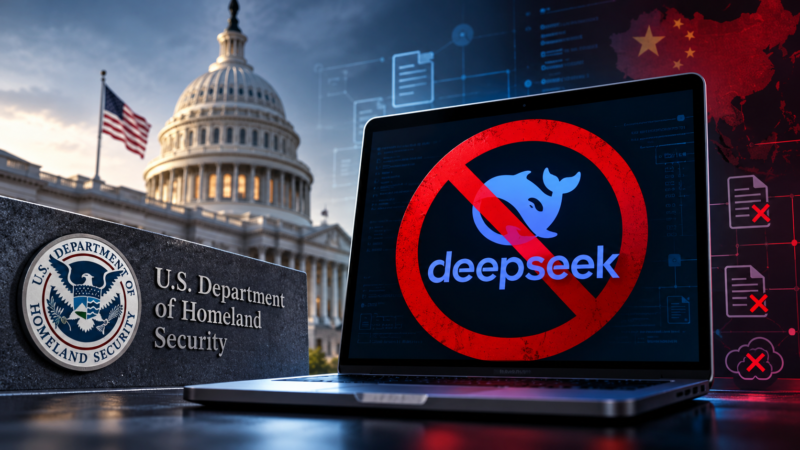
The US Department of Homeland Security has ordered federal civilian agencies to remove products and services developed by Chinese artificial intelligence startup DeepSeek from their information technology systems, while prohibiting further procurement of the company’s products.
The order also covers third-party products and services developed using DeepSeek implementations, extending the restrictions beyond software supplied directly by the Chinese company.
The action has implications for technology suppliers serving the US federal government, as agencies and vendors may need to establish whether their products incorporate DeepSeek technology, including through third-party components.
“What I find particularly interesting about the DeepSeek order is the breadth of its language,” said Gabrielle Hempel, security operations strategist at Exabeam. “The restriction extends beyond DeepSeek itself to third-party products and services developed using its implementations, which raises some significant questions about software provenance and supply-chain compliance.”
The order was issued under the Federal Acquisition Supply Chain Security Act of 2018 and published through the Federal Register on October 20, 2026. It applies to federal civilian agency IT systems and procurement; it is not a blanket prohibition on private businesses or individuals in the United States using DeepSeek.
Third-party products also covered
The restrictions extend to third-party offerings that incorporate DeepSeek implementations. This means agencies must consider not only direct deployments of DeepSeek technology but also products and services that use its models or implementations.
For technology suppliers, identifying those dependencies could become a compliance challenge, particularly when AI models are embedded in products supplied by other vendors.
Hempel said the order highlights a distinction between the origin of an AI model and the security of the environment in which it operates.
“I understand the national security concerns, particularly around data sovereignty and foreign intelligence collection, but country of origin isn’t necessarily a proxy for security risk,” she said. “A locally-deployed model with appropriate controls presents a different risk profile than a foreign-hosted service.”
The distinction is relevant to organisations assessing AI systems because deployment arrangements, access controls and data-handling practices can affect the risks associated with a model. However, the DHS order’s requirements must be assessed according to their stated scope rather than treated as a general assessment of the security of all DeepSeek deployments.
The order provides a mechanism for executive agencies to request exceptions in writing. Requests must identify the affected products, explain why an exception is necessary and describe alternative measures to mitigate the risks addressed by the order.
AI restrictions extend supply-chain scrutiny
The order comes as organisations increasingly incorporate third-party AI models into applications and software development workflows. Restrictions that extend to downstream products can complicate efforts to identify affected components and demonstrate compliance.
Hempel expects such measures to create tension between national security policy and the practical realities of AI development.
“I suspect we’re going to see increasing tension between national security policy and the practical realities of AI development, particularly as governments begin imposing restrictions that extend beyond the models themselves and into the broader software supply chain,” she said.
“The challenge will be making those requirements sufficiently clear and technically enforceable.”
For suppliers to federal agencies, the immediate task is to determine whether their products fall within the order’s scope and whether any exceptions apply. That may require closer tracking of model dependencies, third-party integrations and the provenance of AI components. For other enterprises, the order is not itself a general prohibition on DeepSeek. It does, however, illustrate how government procurement rules can affect the use of AI technology across a wider software supply chain, including products that incorporate models indirectly.