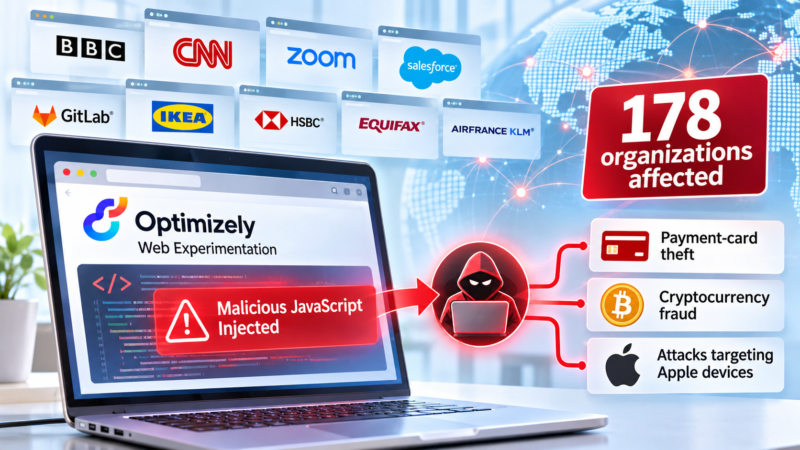
Attackers exploited a vulnerability in the website experimentation platform to inject malicious JavaScript targeting payment cards, cryptocurrency transactions and Apple devices
A vulnerability in Optimizely’s Web Experimentation platform was exploited to inject malicious JavaScript into websites operated by 178 organizations, including the BBC, CNN, Zoom, Salesforce, GitLab, HSBC, Equifax and IKEA, potentially exposing visitors to payment-card theft, cryptocurrency fraud and attacks targeting Apple devices.
The attack affected 188 JavaScript snippets associated with the organizations, according to an investigation by cybersecurity company Report URI. The malicious scripts were delivered through Optimizely’s infrastructure, which the affected websites already trusted to provide website experimentation and customization functionality.
Rather than breaching each organization’s website infrastructure independently, the attackers modified customer-specific JavaScript configurations within Optimizely Web Experimentation. This allowed malicious code to execute in visitors’ browsers when they accessed affected websites.
In a security incident report published on November 17, Optimizely confirmed that an unauthorized third party had exploited a vulnerability in its Web Experimentation account signup process to impersonate customer users and insert malicious JavaScript into their projects.
“This was not a credentials breach,” Optimizely said in its report, adding that the attackers had not stolen or used customer passwords.
A single vulnerability exposed multiple organizations
According to Optimizely’s investigation, the attackers began creating accounts through the platform’s signup process at 00:37 UTC on November 16. The vulnerability allowed those accounts to impersonate existing users on customer accounts through a combination of publicly available information and brute-force attempts.
The attackers then used the impersonated identities to modify Project JavaScript, an optional field within Optimizely Web Experimentation that allows customers to add their own JavaScript code to website experiments.
Optimizely said the first malicious code was written into a customer project at 07:51 UTC.
The compromised code was subsequently delivered through website scripts hosted on Optimizely’s content delivery infrastructure. Because the affected websites already loaded these scripts as part of their normal functionality, visitors’ browsers could execute the injected code without any additional interaction.
Benny Lakunishok, co-founder and CEO of Zero Networks, said the incident demonstrated how attackers can exploit the trust organizations place in third-party services.
“Unfortunately, an attack of this magnitude isn’t surprising. We’ve built an interconnected digital economy where organizations implicitly trust thousands of third-party applications, services and connections. Attackers understand that compromising one trusted provider can be far more effective than attacking hundreds of companies individually,” Lakunishok said in comments shared with Cybernetix.
“What makes this attack particularly striking is that the malicious code was delivered through legitimate, trusted infrastructure. The attackers didn’t need to breach each organization’s systems. They exploited a shared service that those organizations had already given permission to run code on their websites. That allowed a single vulnerability to expose visitors across 178 organizations, including some of the world’s biggest brands,” he said.
Report URI founder Scott Helme said in an investigation published on the company’s blog that the attackers modified the Project JavaScript component while leaving the remainder of the customer scripts unchanged.
The researcher identified three versions of the malicious code, including scripts that loaded an external payload, encoded versions designed to conceal the malicious destination and an inline version capable of executing if the external domain was blocked.
Malicious code targeted financial information and Apple devices
The JavaScript was designed to perform several activities, including replacing legitimate cryptocurrency wallet addresses with addresses controlled by the attackers.
According to Report URI, the script monitored website content, forms and clipboard activity for cryptocurrency addresses. It could replace legitimate addresses with attacker-controlled ones, potentially redirecting transactions when users copied and pasted payment details.
The code also included payment-card skimming functionality. It monitored form submissions and requests for card numbers, expiry dates and security codes, sending captured information to attacker-controlled infrastructure.
Report URI also found that the malware could collect browser-readable cookies and screenshots of webpages under certain conditions.
The campaign included an additional component targeting Apple devices. Report URI identified attempts to deliver the Coruna and DarkSword iOS exploit kits to iPhones and iPads through separate attacker-controlled domains.
Optimizely’s own analysis confirmed that the injected code included a secondary exploit-kit delivery attempt targeting older iOS and iPadOS versions, although its report did not independently identify the exploit kits by name.
The extent of successful exploitation remains unclear. Report URI identified cryptocurrency transactions worth approximately $7,040 reaching attacker-controlled wallets by 19:25 UTC on November 16.
The researcher said the amount represented transactions observed during roughly nine hours of activity. However, it could not establish how many payment-card details or browser cookies had been successfully exfiltrated.
Optimizely similarly said it did not have evidence confirming whether personal data had been exfiltrated. The company said it could establish when malicious code was loaded but could not determine from its own telemetry whether the code successfully extracted information.
Optimizely fixes vulnerability and launches investigation
Optimizely said it detected the malicious activity at 13:34 UTC on November 16 and deployed a fix for the signup vulnerability at 16:10 UTC.
It subsequently terminated active sessions, revoked tokens and reset access for impersonated users. The company said all injected code had been removed from affected projects by 22:24 UTC.
The company also engaged cybersecurity firm Mandiant to conduct an independent forensic investigation alongside its internal security team.
Optimizely said the incident was limited to its Web Experimentation product. Its Feature Experimentation service, software development kits and legacy Full Stack product were not affected.
The company recommended that affected customers investigate website activity during the exposure window, review content security policy violation reports and examine payment-card and cryptocurrency transactions.
It also said websites using a strong Content Security Policy (CSP) could have blocked the malicious external scripts.
Lakunishok said organizations need to reconsider how they manage trust across interconnected systems and services.
“We still trust far too much, and that trust is embedded in the architecture of our digital infrastructure. We need to fundamentally rethink security so that trust never means unrestricted access. Every system, application and connection needs enforceable boundaries that limit what a compromise can affect,” he said.
“The surprising thing isn’t that this attack happened. It’s that we continue to build environments where one compromise can have such an enormous reach.”
Report URI said most of the infected code had been removed by late November 16. In its final sweep at 21:52 UTC, it found malicious code in only one of the 188 infected snippets, down from 169 at 20:56 UTC.