NordPass’s 2026 research finds little change in password habits, with ‘admin’ and ‘12345678’ retaining their positions near the top as pop-culture references increasingly influence credential choices.
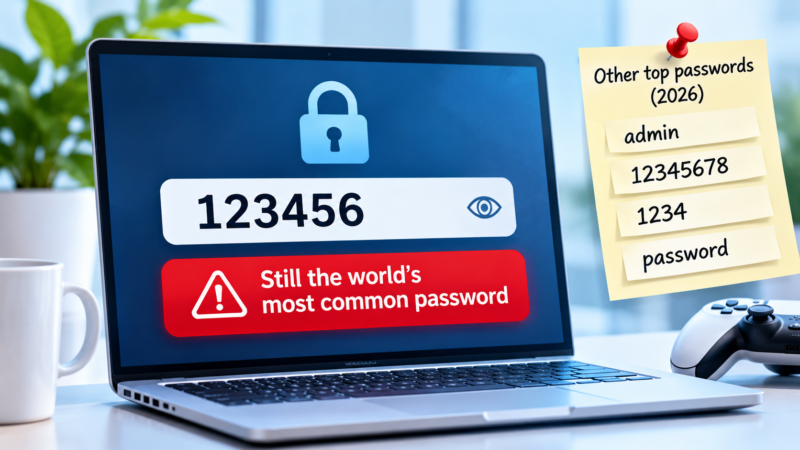
The password “123456” has retained its position as the world’s most commonly used password for the seventh time in eight years, underscoring the persistence of weak authentication practices despite years of cybersecurity awareness campaigns.
The finding comes from the 2026 edition of NordPass’s annual Top 200 Most Common Passwords report, which analyzed credentials exposed in public data breaches and dark web repositories between September 2025 and September 2026. The research was conducted jointly by NordPass and NordLayer Intelligence by NordStellar, with support from independent cybersecurity researchers.
The top three positions have remained unchanged, with “123456” followed by “admin” and “12345678”. The password “password”, which previously ranked higher, moved to seventh place, while “1234” entered the top five.
The findings indicate that users continue to favor short, predictable combinations and familiar words despite the risks associated with credentials exposed in data breaches.
NordPass analyzed password trends across 44 countries. The researchers statistically aggregated exposed credentials and said they did not acquire or purchase personal data for the study.
Pop culture finds its way into passwords
The 2026 report also examines how entertainment, sports, gaming and internet culture influence password choices.
Passwords inspired by popular culture include references to musicians, athletes, video games, anime, television shows and internet memes. Examples in the report include “metallica,” “minecraft,” “skibiditoilet” and “squidgamethebest”.
NordPass found that sports-related references were the most frequently used category among the pop-culture passwords it examined, while video games and anime accounted for the largest share of entries.
The research also identified passwords reflecting events and cultural trends from different periods. COVID-related combinations, including “Covid@19” and “Covid-19”, featured among passwords associated with the 2020s.
The report noted that pop-culture references can make passwords easier to guess because they are widely recognizable and can be incorporated into password-guessing dictionaries used by attackers.
“Fandoms make for terrible passwords,” NordPass said in its report, noting that passwords inspired by popular culture could be cracked in seconds.
Weak passwords remain an enterprise risk
The persistence of predictable passwords has implications beyond individual accounts. Corporate credentials exposed through data breaches can provide attackers with material for credential-stuffing attacks, in which previously compromised username-password combinations are tested against other services.
Password reuse increases this exposure because a credential leaked from one service may also unlock an employee’s account on another platform.
For organizations, the problem extends to administrative accounts, remote access services, cloud applications and other systems that rely on password-based authentication.
The NordPass findings do not measure the number of successful attacks attributable to weak passwords. However, the recurrence of easily guessed combinations in exposed credential datasets highlights the continuing challenge of improving authentication practices.
The report also points to the limitations of relying on users to create memorable passwords. Even combinations that include names, numbers or special characters may remain predictable when they follow familiar patterns.
Passkeys and multifactor authentication offer alternatives
NordPass recommends using unique passwords for individual accounts, longer passwords or passphrases, and multifactor authentication (MFA) to reduce the risk of account compromise.
It also recommends password managers to generate and securely store different credentials rather than relying on users to remember multiple complex combinations.
The company is also promoting passkeys as an alternative to conventional passwords. Based on public-key cryptography and supported by the FIDO Alliance, passkeys allow users to authenticate using device-based credentials, such as biometrics or a device PIN, without entering a conventional password.
For enterprises, adopting phishing-resistant authentication methods, enforcing MFA and monitoring exposed credentials can reduce the risk associated with stolen or reused passwords.
The 2026 findings suggest that the challenge is not simply creating more complex password policies, but reducing dependence on passwords that users can easily remember and attackers can readily guess.